

AI Productivity: If We Find the Time, What Next?
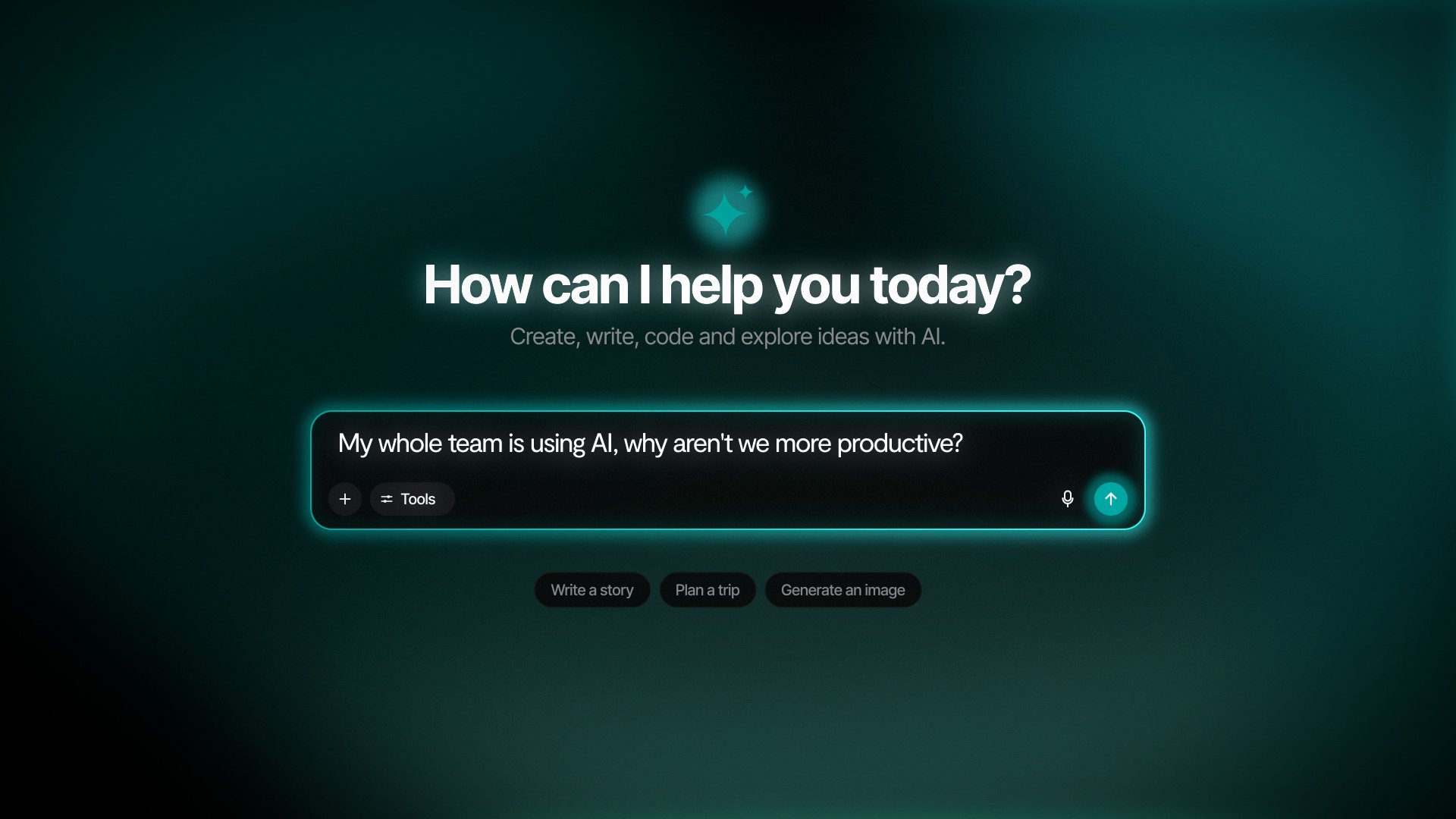
So, what are we going to do with all this time, then?
Every AI business case I've seen recently is built on the same promise, which is hours saved. A million hours, ten thousand hours, two hours per person per week. The number changes depending on how brave the person building the slide was feeling.
What strikes me to date is that almost nobody has answered the second question, which is what those hours are actually for.
That sounds like a philosophical detour, exactly the sort of thing you'd expect from a bloke who's recently discovered Heifetz and wants everyone to know about it. Fair enough, but it's also the thing that decides whether any of this works.
MIT's research on enterprise AI found that 95% of pilots delivered no measurable impact on the P&L, despite somewhere between thirty and forty billion dollars going into them. The number's been argued about since, fairly, and I'd take it with a pinch of salt. The finding underneath it has held up better. The failures weren't caused by the technology, they were caused by poor integration and misaligned priorities... which is the polite way of saying the organisation wasn't ready for what it bought.
Many organisations have spent the last two years measuring adoption. Licences issued, weekly active users, prompts submitted. Adoption metrics are the corporate equivalent of a Duolingo streak, which is to say everybody's got one and almost nobody can order a coffee in French. To be fair, I think we're seeing the end of this in places, and the better organisations are already moving on from it. The rest are about to find they've been diligently measuring the wrong thing for two years running.
The gap isn't capability. It is that individual capability and collective capability are not the same thing and most programs only focus on building the first one... then they look around puzzled when nothing happens.
So what’s the solution?
Three capabilities, and they only work as a set.
We've been chewing on this at Interchange for a while, mostly because we kept watching well-intentioned AI programs produce very little. What we've landed on is three capabilities that need building deliberately and a firm view that they can only do their job as a set.
-
Critical thinking is the discipline of not accepting an output simply because it turned up faster than you could have checked it. Research from BetterUp Labs and Stanford, published in HBR, found that 41% of workers had received AI-generated work that looked finished but had nothing underneath it. Each instance cost the recipient about two hours of rework. They called it ‘workslop’, which I like to think of as AI slop that's put on a lanyard and come into the office.
There's a follow-up from Oxford and Babson that's worse, where all that low quality output degrades the information the organisation then uses to make its decisions. ‘Knowledge decay’, they called it. It looks like productivity and behaves like debt. It's the professional equivalent of eating a donut on the treadmill, where you're technically moving but getting absolutely nowhere.
-
Systems thinking is the second, and it's the one we haven't seen deliberately built in many places. Commonwealth Bank is the cleanest example I could find, they cut 45 contact centre roles after bringing in an AI voice bot, on the basis it had reduced call volumes by 2,000 a week. The Finance Sector Union took it to the Fair Work Commission and pointed out that volumes were in fact going up, that staff were being offered overtime, and that team leaders had been put on the phones to cope. CBA reversed the decision and publicly called it an error, which took a fair bit more nerve than most organisations can manage.
Nobody at CBA was incompetent, they measured the tool instead of the system. Calls through one channel went down while total work went up, and there was nobody whose job it was to look at the whole thing until somebody from outside made it their business. If you want a working definition of a systems problem, that's it. A room full of clever people all correctly reporting their own numbers while the organisation reverses into a wall.
I wrote about this the other week, but Canva went the other way with much the same problem. Facing AI costs that threatened the entire business model, their fix had to be a better system. Routing tasks to whichever model does that job best, building specialised tools for specific workflows, using their existing library instead of generating everything from scratch. Canva reported cost reductions of up to 90%. Nothing about that is an AI insight, it's resource allocation, which is a point I've made before and will presumably keep making until somebody stops me. The Ferrari shouldn't be doing the school run.
-
Adaptive leadership is the third, and it's what makes the other two stick. Heifetz and Laurie drew the line between:
technical challenges: which have known solutions an expert can deliver
and adaptive challenges: where the answer can't be imported because it needs people to change their values, habits and relationships.
Technical problems you can outsource, and plenty of people will happily take your money. Adaptive ones are more like getting fit, where you can absolutely pay somebody to design the program but there's nobody can do the exercise on your behalf.IBM automated HR and the system handled around 94% of routine requests, which is genuinely impressive. It could not handle the other 6%, which turned out to be the ethical dilemmas and the judgment calls. Anyone who has worked in HR could have named that 6% in advance, and would have enjoyed doing it.
Critical thinking gets you judgment. Systems thinking gets you scale. Adaptive leadership is what makes either of them hold.
Importantly, does this mean we can all spend more time in the pub?
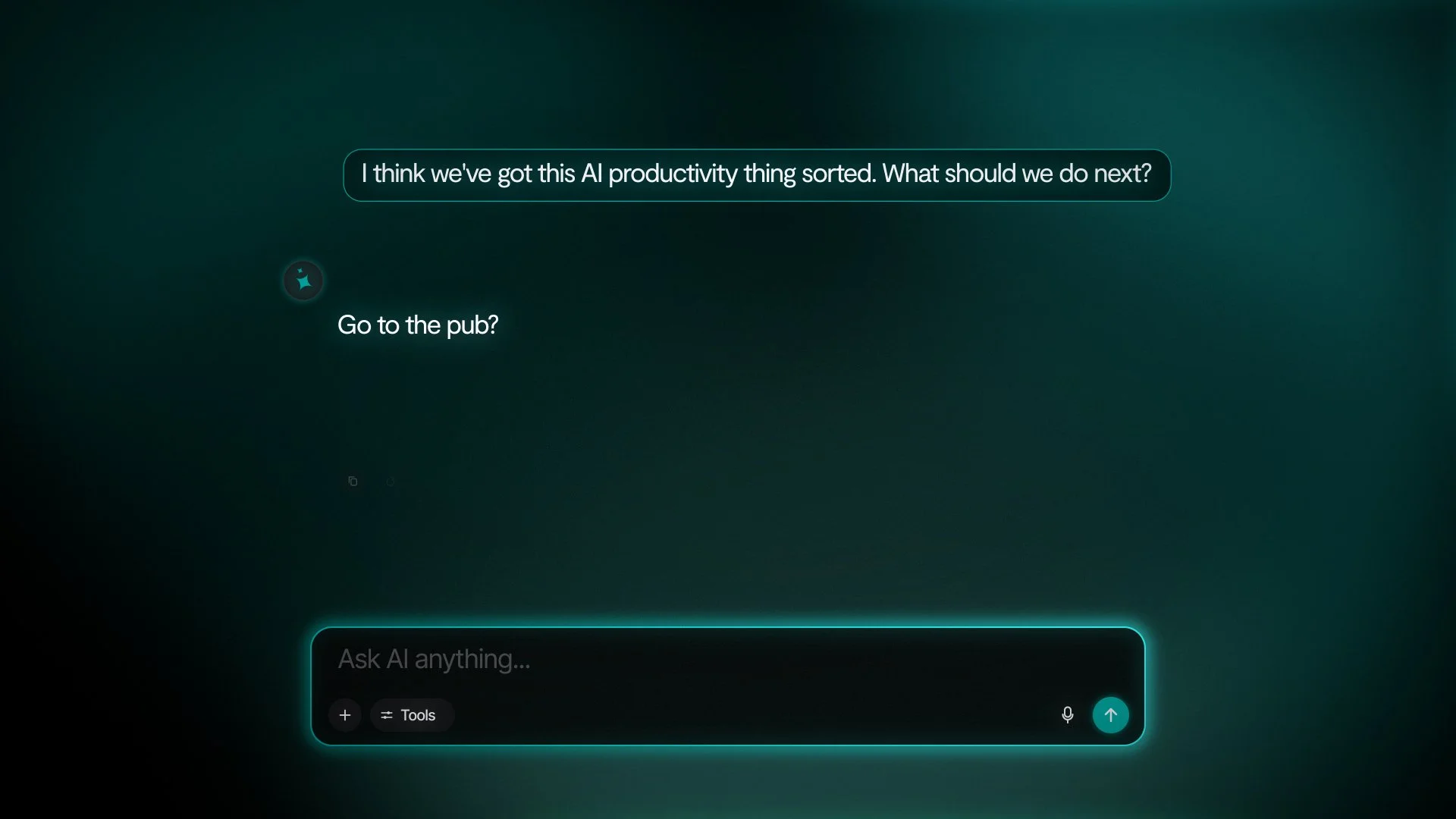
Maybe, maybe not, but let's assume it all works. The capability lands, the systems are designed properly, the hours stack up. What's next?
What we're seeing at the moment is that organisations aren't really planning beyond that point, because the business case ended at the saving. Nobody fancied writing the slide called "err... then what," largely because there's no number to put on it and it's very hard to make a chart out of an open question.
From what we can see, reclaimed time goes one of three ways when nobody decides in advance what it's for.
1. It gets absorbed
which is the most common and least dramatic outcome. Cyril Parkinson, a British naval historian, worked this out in 1955 when he noticed the Admiralty's bureaucracy growing while the actual work shrank. Work expands to fill the time available for its completion, and he managed to spot it without a single AI pilot or a change management partner. Think more meetings, more reporting and more of the same work at higher volume. Workslop is this in its purest form, where the time one person saved producing something gets spent by somebody else fixing it, and everybody's dashboard still looks excellent.
2. It gets extracted
which is where 2026 has been quite instructive really. In March, AI became the most cited reason for workforce reductions for the first time. Then came the boomerang, Ford rehired and promoted more than 350 experienced engineers after automated quality control failed to capture what the veterans knew. Klarna cut support from around 2,300 to 1,600, let AI handle roughly 70% of interactions, then brought people back when quality slipped. IBM, having automated HR, announced plans to triple US entry level hiring, which I imagine involved a meeting nobody enjoyed and at least one very careful email.
The numbers underneath are interesting too, 39% of business leaders had made AI-driven cuts and 55% later worked out it was a mistake. Gartner reckons half of all AI-attributed headcount reductions will reverse by 2027, usually under a different job title, because nobody enjoys admitting they've rehired the person they made redundant eighteen months ago, particularly on a better salary.
3. Or it gets wasted
where people fill the gap with whatever's nearest, because nobody ever told them what mattered more.
What's the point in all this?
If AI does the work that made people feel useful, what's left that feels like work worth doing?
This is the point where a productivity conversation turns into an existential one, usually around four o'clock on a Thursday, shortly after the algorithm has served you a Diary of a CEO short explaining that humans will be fuel for data centres by Christmas 2028. You'll know it's happened because somebody in the corner develops a thousand yard stare, gazing off into the middle distance, or the abyss, depending on how the week's gone.
A great deal of professional identity is built on being the person who can do the difficult thing, and when the difficult thing becomes easy, a new challenge must replace it or people quietly check out while continuing to attend every meeting in the calendar. Ford's engineers are the example running the other way, where their knowledge turned out to be exactly the thing the system couldn't replicate. I like to imagine they strutted back into the office like a supermodel on a Paris catwalk when they were recalled.
My honest position is that the work that stays human is judgment under ambiguity, relationships that carry weight, and responsibility that can't be handed to a system. All of which are the activities that could make up IBM's 6%.
The work worth doing more of is the stuff everyone always said they'd do if they had the time. Thinking further ahead than next quarter, developing people properly rather than in the fifteen minutes before their review. Solving the problem instead of managing it, indefinitely, in a recurring fortnightly slot that people stopped questioning years ago. I've sat in that meeting. Heck, I've probably owned it.
Where this lands for me, at least…
There's no technical answer to what meaningful work is. Nobody's built the tool, and if somebody does, that'll be the clearest possible sign we've all misunderstood the problem. You can't import it from a consultant, which is an awkward thing for me to write, and you certainly can't lift it out of a framework however nicely designed. It has to be worked out by the people doing the work, which is the definition of an adaptive challenge and a fair explanation of why it keeps getting pushed.
The capability required to find the time is the same capability required to spend it well. The places treating the productivity hours as the finish line will bank the saving and wonder why nothing changed. The ones treating it as a starting point are the ones that'll really get somewhere.
I don't have this fully worked out, which is probably obvious by now. What I'm fairly sure of is that the time arrives whether or not anyone's thought about it, and that's the bit worth getting ahead of.
The hours are coming, whether you've planned for them or not.
The organisations that treat this as a finish line will bank the saving and stall. The ones that treat it as a starting point will find out what their people are actually capable of.
If you want to work out what that looks like for you, get in touch.