
The SpaceX Mirror: What the Race to Space Reveals About Your Organisation
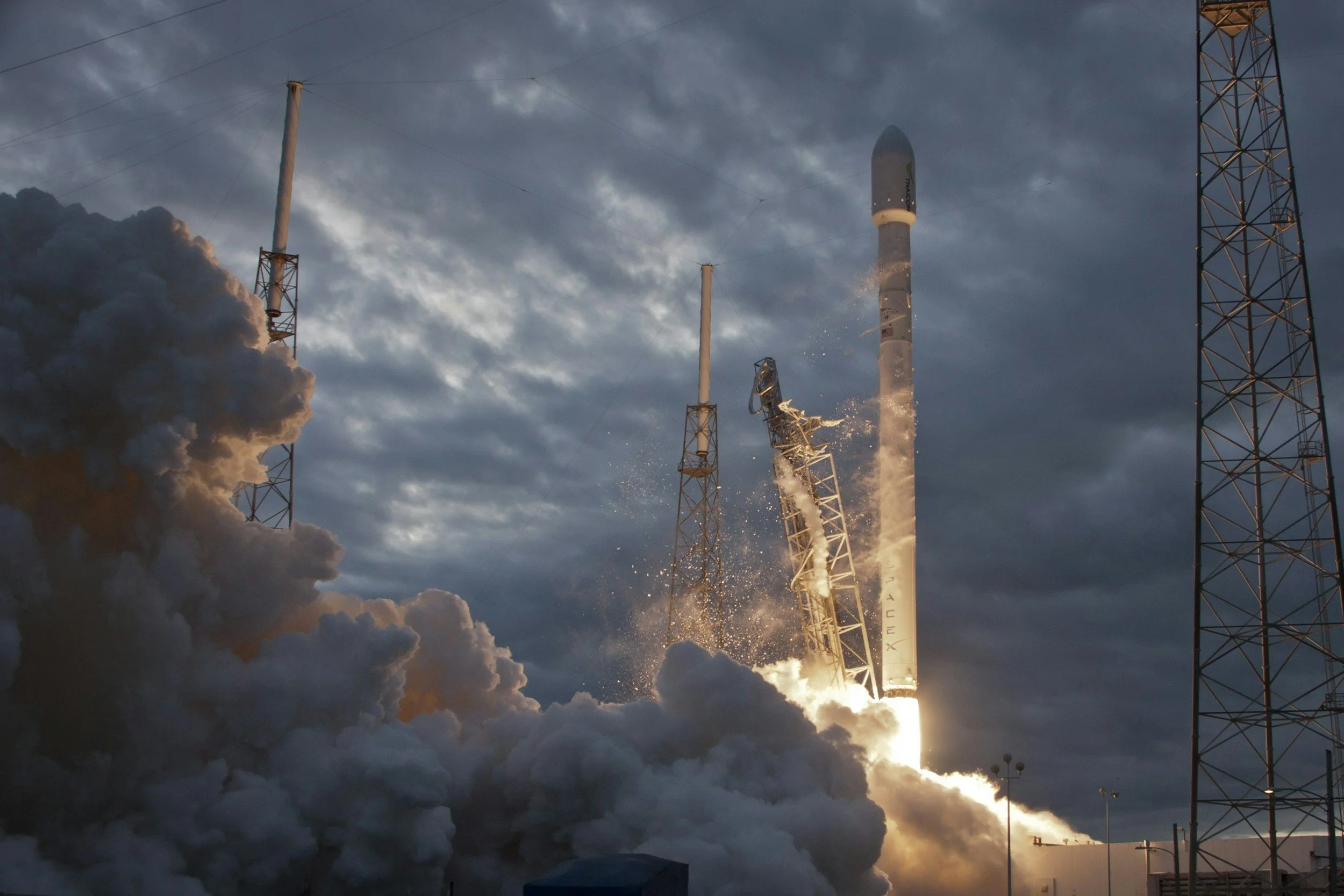
Seven years ago, I was asked to present on the cultural implications of space colonisation through my work with the Future of Space community. The conversation that followed led to KPMG inviting me to speak to their global space industry advisory team. The questions being posed at the time were ‘who will get there first?’ and ‘what does that mean for everything that follows?
Those questions felt speculative in 2019. Today, with SpaceX completing the largest IPOs in financial history at a valuation of US$1.75 trillion, it feels urgent. The number itself is significant sure, but it is what is happening underneath that valuation and what it tells us from a systems lens at a societal level is the most interesting part. If we choose to look beneath what the media is reporting on, SpaceX can tell us something about what is happening inside most organisations right now.
The race that matters most isn’t about rockets
When I spoke about space colonisation, my central premise was that the race to be first matters most because of culture, not technology. History offers only two versions of how the social code gets set. You arrive into an existing culture and inherit its frame, as every wave of immigration demonstrates, or you erase what was there and write your own. We’ve tried the latter several times, as the colonisation of the Americas and Australia demonstrates, at devastating cost.
Space appears to offer a third scenario of a blank slate. The scientific community is however debating this fiercely, and rightly so. NASA’s own missions have been partly designed around the question of microbial life on Mars. Setting that aside and accepting the blank slate version, the question becomes who fills it. The group to arrive first will shape what is normal, what is acceptable, what is expected. Every group that arrives after will adopt and influence those norms, but they won’t craft them. This is now mainstream strategic thinking. A recent AFR analysis of the SpaceX IPO stated, “whoever controls space writes its rules and language.”

What’s not being discussed at any depth is what are the characteristics, values and ways of living embodied by the people we are sending there. How will they consciously and unconsciously shape the norms and are we happy with that? I can find no evidence that we are preparing to learn from our past endeavours and considering how we to do this differently. I wonder if this is just another version of the Titanic whereby those with the most money have access to the lifeboats whilst those in the bows sink to their depth?
The narcissism-selection effect
Most people in Australia will have some form of investment in SpaceX whether they chose it or not. Australian superannuation funds, global index funds, and ETFs will carry SpaceX as a matter of course. Whilst a casual worker and an Executive may now have a stake in the same company, what they do not share is agency. The price of meaningful entry correlates heavily with extreme wealth. That correlation matters more than it might first appear.
The research on narcissistic leadership is consistent. A healthy dose of narcissism, what the literature calls proactive narcissism, drives vision, risk tolerance, and the capacity to bring others on a journey they have never been on before. In fact, more recent research suggests that it is a prerequisite trait of senior leadership. The problems begin when the narcissistic traits present as what Kets de Vries calls reactive narcissism. Three facets cluster in leaders with reactive narcissism:
The drive to dominate through leadership as both a symbol of self-importance and to maintain a false sense of control.
An insatiable need for admiration and recognition.
The belief that they deserve special treatment and that other people exist primarily to serve their goals.
People with all three are statistically more likely to accumulate extreme wealth. They are also more likely to be on the rocket.
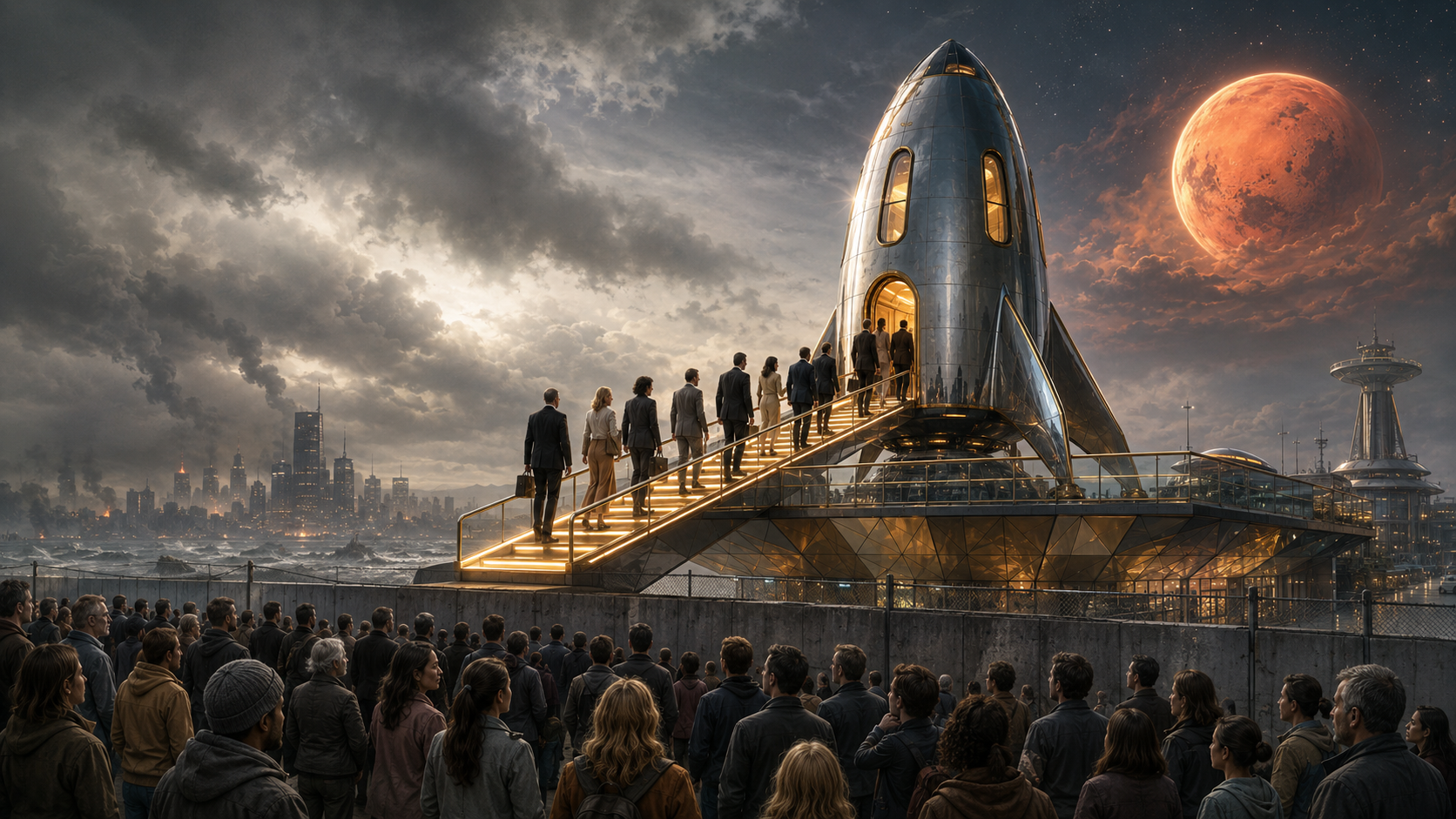
This is what the research calls the narcissism-selection effect: when a system mistakes the accumulation of capital for the accumulation of wisdom. When we populate a new civilisation, or a new leadership team, with people high in reactive narcissism, we cannot escape the forces we claim to want to leave behind. Instead, we replicate, with fresh energy and new territory, the same dynamics we wish to depart from.
Systems psychodynamic theory has a name for this: the compulsion to repeat. It describes our tendency to recreate, in new contexts, the patterns we know best. It explains why cultures persist long after the conditions that created them have changed. The problem with the space race is that we have not stopped to ask what we are bringing with us and why.
Technology has always run ahead of our capacity to reckon with it
To be controversial, I don’t believe that SpaceX is unprecedented. It is the latest iteration of something we have done before. The industrial revolution gave us extraordinary gains in quality of life. Heating, communication, medicine, the building materials that shelter us. The smartphone in your pocket is a direct descendant of the technologies that came out of that era. We are still discovering the costs. Climate change is not a surprise. It is a delayed consequence of a transformation we did not fully understand at the time we embraced it.
Much of the SpaceX valuation has been reported as unrealised AI gains rather than rocket engineering. But when we really break it down, is AI structurally any different to the industrial revolution? The benefits are real, visible, and immediate. The costs are deferred, distributed, and will take time to be fully felt. I would argue that the full humanitarian impact of AI will not be visible for more than a decade.
We have been here before at an organisational level too. When mechanised coal mining was introduced in 1950s Britain without attending to the social system surrounding it, the result was defiance and collapsed productivity. That may sound familiar to you with all the headlines about Australia’s current productivity crisis. The technology was sound but the human system was inadequately catered for. That is what happens when organisations defend against the anxiety of change rather than address it. In the systems psychodynamic discipline, we call these social defences. The productivity cost is the predictable consequence. That pattern is as relevant to your AI transformation today as it was to a Yorkshire coalmine in 1951.
The trillion-dollar saviour
SpaceX has annual revenues of US$19 billion and posted a net loss of nearly US$5 billion last year. It trades at 140 times sales. When Google listed in 2004 it listed at 24 times. As financial analyst Jim Chanos observed, “somewhere close to $2 trillion of SpaceX’s valuation is associated with a largely unproven AI business.” If the mathematics do not explain the valuation, what does?
Wilfred Bion, the psychiatrist and group theorist whose work underpins much of what we understand about unconscious group behaviour, identified what he labelled ‘basic assumption’ states. These are modes of group functioning that emerge when collective anxiety becomes too high to sit with rationally. In the dependency mode, group members act as though they are inept and look to a leader they have cast as a saviour. In the fight/flight mode, they act as though the source of the group’s trouble is a discrete external threat that must be destroyed or escaped at all costs.
SpaceX, understood through a Bionian lens, is the most literal enactment of fight/flight in human history - a rocket. Its primary narrative is escape. Its secondary narrative is conquest. Musk as CEO has been cast, by markets, by media, and by millions of retail investors, in the role of saviour.
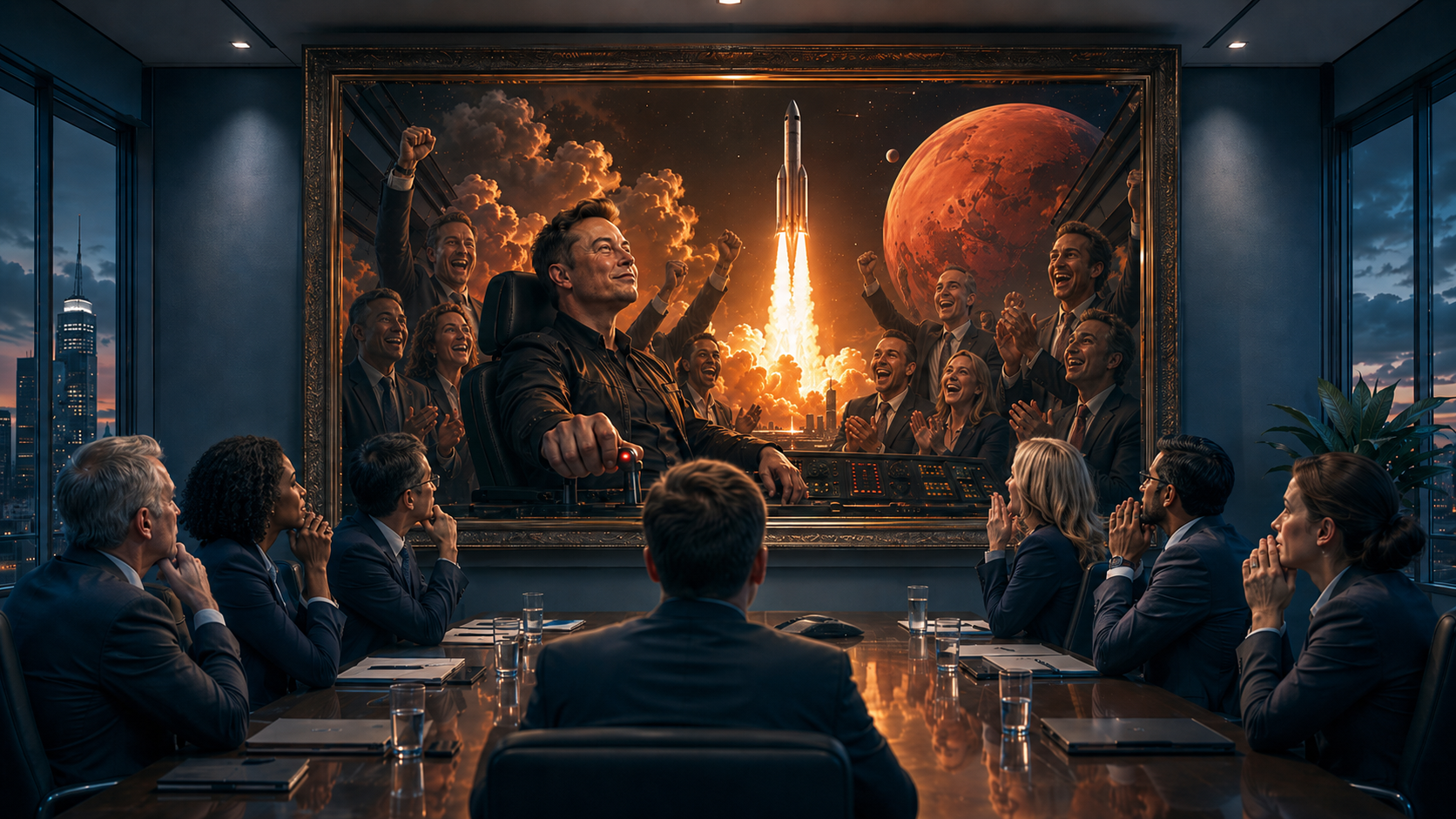
This is not accidental. Kets de Vries describes a two-way dynamic between reactive narcissistic leaders and what he calls the ‘ideal-hungry followers’. Followers project their imagination of the ideal leader onto an individual in a position of power. The leader reflects back to the followers these exaggerated and unreal traits in the glow of their admiration. The result is a hall of mirrors in which the reality-check collapses for both parties, having surrendered their critical thinking to the dependency relationship. This dynamic works best when the group’s distress is highest. The more overwhelming the anxiety, the more divorced the ideal becomes from reality.
We are living through a period of profound collective distress about what AI means for work, for identity, for the planet and ultimately, the future of humanity. That anxiety does not have an adequate container. Into that vacuum, a figure with a rocket and an earth-shattering valuation presents themselves as the answer. The market is not valuing a business. It is managing anxiety through a saviour narrative.
Napoleon, said that leaders are merchants of hope. What SpaceX is selling is not satellite communications or AI coding tools. It is hope. The price of hope, it turns out, is approximately two trillion dollars of unproven valuation.
What this means for your leadership team right now
The dynamics playing out at civilisational scale, the narcissistic leadership traits, the compulsion to repeat dysfunctional patterns in new contexts, the basic assumption of dependency on a saviour figure, the fight/flight response to existential anxiety, are not unique to SpaceX. They are playing out in almost every organisation right now, in response to the same underlying stimulus.
Every leadership team facing an AI transformation is experiencing a version of this. The anxiety is real. The pressure to act is real. The temptation to find a charismatic figure, internal or external, to hand the uncertainty to is real. The risk of mistaking that handover for a strategy is equally real.
Social defences, as we saw in the coalmine and as we are seeing again now in the productivity headlines, are what organisations construct when the anxiety of genuine change is too high to hold. A strategy document, a transformation roadmap, a restructure, can all function as a defence rather than a plan. The pattern is the same dynamic, across different centuries, wearing different clothes.
We asked who gets to board the rocket and what they are unconsciously carrying with them. The same questions apply to your organisation. Who is being cast as saviour, and what is that role protecting everyone else from having to think and feel? Who is in the founding population of your transformation, and what culture are they setting before anyone else arrives? When the question comes up, as it inevitably does, of what we are really trying to solve for, who is brave enough to go deep?
The price of not exploring this is always paid by the people furthest from the power. The anxiety the leadership team cannot hold lands on those below them. The cost of the basic assumption is socialised. The benefit of the saviour narrative accrues to those who were already protected.
SpaceX is showing us, in high definition and at extraordinary scale, what happens when a group manages its existential anxiety through dependency on a saviour, through the selection of a founding population that reflects its existing pathologies, and through the basic assumption of fight/flight dressed up as vision.
The question for your organisation is not whether these dynamics are present. They are present in every human system under pressure. The question is whether you are willing to look at them. Whether you have the capacity to do something other than reach for the nearest rocket.
Leaders may indeed be merchants of hope. The best ones, however, are also honest about the price and prepared to do the work that doesn’t travel at the speed of a rocket.
If your leadership team is navigating AI, transformation, growth or cultural pressure, we can help you uncover the hidden dynamics shaping your decisions.
References
Bion, W. R. (1961). Experiences in groups. Tavistock Publications.
Choi, Y., & Phan, W. M. J. (2022). Narcissistic leaders: The good, the bad, and recommendations. Organizational Dynamics, 51, 1–12.
Kets de Vries, M. F. R. (2003). Dysfunctional leadership. INSEAD Working Paper 2003/58/ENT.
Nadaradjane, A. (2026). Musk’s SpaceX IPO matters far beyond Wall Street. Australian Financial Review.
Petriglieri, G., & Petriglieri, J. L. (2020). The return of the oppressed. Academy of Management Annals, 14(1), 411–449.
Thomson, J. (2026). $1.3trn in three days: SpaceX is a meme stock now. Australian Financial Review.
Trist, E. L., & Bamforth, K. W. (1951). Some social and psychological consequences of the longwall method of coal-getting. Human Relations, 4(1), 3–38.